The Ghosts of Roebuck Bay by Ian Winton Shaw
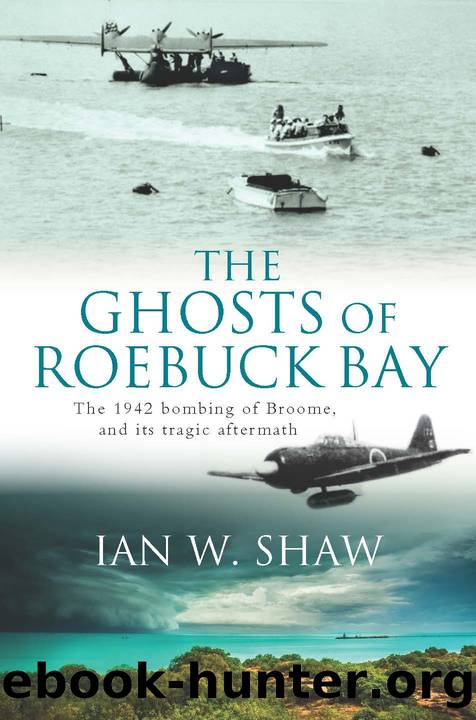
Author:Ian Winton Shaw
Language: eng
Format: mobi, epub, pdf
Tags: Australia & New Zealand, Australia & Oceania, History
Publisher: Macmillan Australia
Published: 2014-09-01T14:00:00+00:00
CHAPTER 8
The Port Hedland Races
There are about 65 white men living in Broome, the majority of whom appeared to be extremely panicky, and are very apprehensive of the position in which they find themselves.
Charles Snook
Even before the last survivors had been pulled from the waters of Roebuck Bay, plans for the evacuation of Broome were being hatched by the USAAF command and some of the local inhabitants. In some cases, some planned to evacuate just themselves, leaving the others behind to fend for themselves and anyone else in the town. Those who lived in Broome, including those in authority there, assumed that the servicemen and civilians who had faced the Japanese in the NEI and Malaya knew from that experience what to expect from those Japanese. It was a false assumption. In the campaigns fought thus far in Southeast Asia, raids such as the one just experienced by Broome were often followed up by the landing of Japanese troops to seize the strategic location, a point which was made repeatedly after the Zeros had flown away.
For those in Broome, this theory rapidly became an accepted fact. No-one could deny that Broome had become a key point in Allied planning in the past two weeks. Some of the people predicting a Japanese invasion were the same who had watched Japanese reconnaissance aircraft fly over the town the previous a/fternoon and said that there would be a full-blown Japanese raid on the town within 24 hours. They had been correct then, and if they were correct again, a Japanese invasion fleet was somewhere below the horizon, and would soon be steaming into Roebuck Bay.
Finally, there was the evidence in front of them. The Japanese raid had lasted barely fifteen minutes and was very destructive, but it had also been very targeted. Every aircraft in Broome at the time of the raid, with the exception of Jack Lamadeâs little Seagull, had been destroyed in the air, on the ground or on the water. But only aircraft were destroyed. Broomeâs two key strategic assets â its airfield and its jetty â were still intact. It was almost as if they had been deliberately spared so they could continue to be used by the Australians and Americans until they were available for use by Japanese occupation troops. In the face of all this seemingly overwhelming and incontrovertible evidence, flight from Broome before the Japanese landed was the only sensible survival strategy.
So, throughout Broome in the hours after the Zerosâ departure, evacuation plans were made by military and civilian alike. The plans they made fell into three broad categories: formal, semi-formal and informal. The formal were those put in place, sanctioned and operated by the authorities then operating in Broome, primarily Colonel Richard Legg and his USAAF administrators. The semi-formal were authorised and sanctioned, but by the military and civilian authorities. The informal were those when an individual, or sometimes a small group, decided to simply up and leave before the Japanese arrived. The problem was
Download
The Ghosts of Roebuck Bay by Ian Winton Shaw.epub
The Ghosts of Roebuck Bay by Ian Winton Shaw.pdf
This site does not store any files on its server. We only index and link to content provided by other sites. Please contact the content providers to delete copyright contents if any and email us, we'll remove relevant links or contents immediately.
The Vikings: Conquering England, France, and Ireland by Wernick Robert(84268)
Ali Pasha, Lion of Ioannina by Eugenia Russell & Eugenia Russell(40273)
The Conquerors (The Winning of America Series Book 3) by Eckert Allan W(37481)
The Vikings: Discoverers of a New World by Wernick Robert(36986)
Cecilia; Or, Memoirs of an Heiress — Volume 1 by Fanny Burney(32569)
Cecilia; Or, Memoirs of an Heiress — Volume 2 by Fanny Burney(31969)
Cecilia; Or, Memoirs of an Heiress — Volume 3 by Fanny Burney(31949)
Empire of the Sikhs by Patwant Singh(23094)
The Secret History by Donna Tartt(19132)
Hans Sturm: A Soldier's Odyssey on the Eastern Front by Gordon Williamson(18604)
Cat's cradle by Kurt Vonnegut(15380)
Pimp by Iceberg Slim(14537)
Sapiens: A Brief History of Humankind by Yuval Noah Harari(14404)
Talking to Strangers by Malcolm Gladwell(13394)
Norse Mythology by Gaiman Neil(13387)
Leonardo da Vinci by Walter Isaacson(13351)
4 3 2 1: A Novel by Paul Auster(12419)
Underground: A Human History of the Worlds Beneath Our Feet by Will Hunt(12106)
The Radium Girls by Kate Moore(12045)
